
Hand Therapy in Surrey After a Wrist Fracture
One second you’re walking to the car. The next, your foot slides on a pile of wet leaves and your hand shoots out to catch you. Now your wrist is in a cast, and you’re wondering how long it will be before you can open a jar, type at work or carry groceries again.
The good news is that most wrist fractures heal in a series of stages, and hand therapy in Surrey can guide you through each step. This post walks you through how these breaks usually happen, the stages of recovery, and what therapy looks like along the way.
How Wrist Fractures Happen
The most common wrist fracture is a break in the radius, the larger of your two forearm bones, just above the wrist. Doctors call it a distal radius fracture.
Most of these breaks happen the same way: you fall and land on an outstretched hand. Your arm takes the full force of the fall, and the end of the radius gives way.
Why a simple fall can break a wrist
If a slip from standing height breaks your wrist, it may be a sign your bones are less dense than they should be. That’s worth a conversation with your family doctor about a bone health check, especially if you’re over 50. It’s one of the easiest ways to lower your risk of a future fracture.
What Affects Your Wrist Fracture Recovery
No two wrist fractures heal exactly alike. These factors shape your timeline the most:
| Factor | Why it matters |
|---|---|
| Type of break | A clean break that stays in place usually heals faster than one that shifts or runs into the joint. |
| Cast or surgery | Some breaks heal well in a cast. Others need plates or pins to hold the bone in place. |
| Age and bone health | Bone heals at any age, but lower bone density can slow things down. |
| Your job and hobbies | Heavy lifting, typing or sport each need different kinds of strength and motion. |
| Your general health | Other health conditions can affect how quickly you heal. |
Cast or surgery: what the research says
A guideline from the American Academy of Orthopaedic Surgeons found that for adults 65 and older, surgery didn’t lead to better long-term results than a cast, although it did show some short-term gains (American Academy of Orthopaedic Surgeons, 2020). For younger adults whose bone has shifted out of place, surgery tended to give better results. Your surgeon will weigh these factors with you.
Wrist Fracture Recovery at a Glance
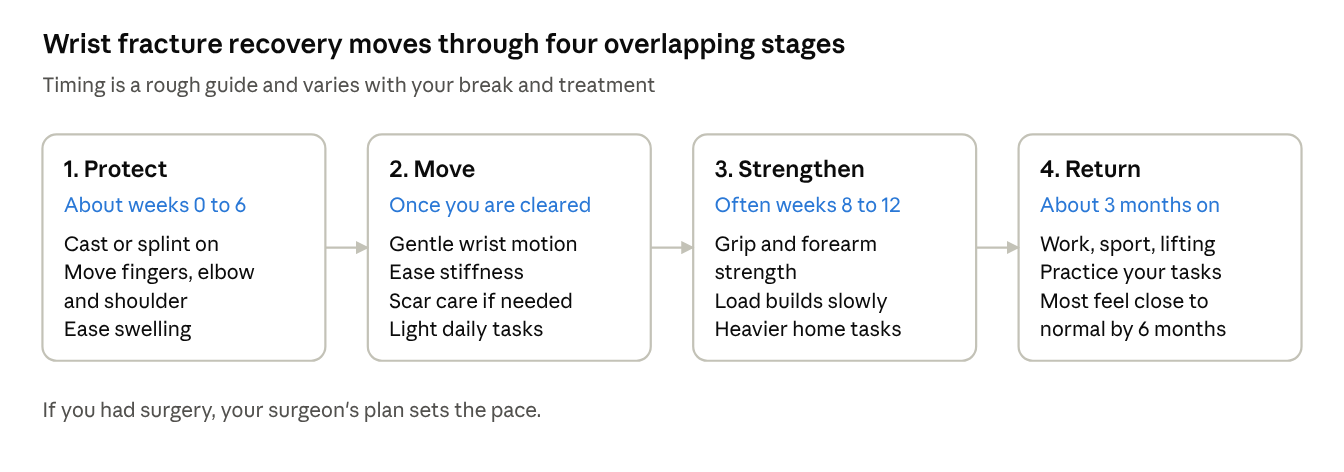
Each stage builds on the one before, and they often overlap. The next section explains what therapy looks like in each one.
The Stages of Hand Therapy After a Wrist Fracture
The timing below is a rough guide. Your bone, your surgeon’s plan and how you’re feeling will set the real pace. Stages also overlap, so you might be working on motion and strength at the same time.
Stage 1: Protect the bone (about the first 6-8 weeks)
Your wrist is in a cast or splint while the bone knits back together. Your wrist needs rest, but the rest of your arm doesn’t. Keeping your fingers, elbow and shoulder moving now makes the next stages much easier.
In therapy, this stage usually includes:
- gentle finger, elbow and shoulder movement
- ways to manage swelling, like keeping your hand raised
- tips for one-handed daily tasks
Stage 2: Get your wrist moving again
Once your surgeon clears you, the cast or splint comes off and the real work begins. Your wrist will probably feel stiff, weak and a little foreign. That’s normal. After weeks of stillness, your nervous system is protective, so movement can feel more alarming than it actually is.
In therapy, this stage usually includes:
- gentle wrist bending, straightening and turning
- swelling and scar care if you had surgery
- light daily tasks, like brushing your hair or holding a cup
Stage 3: Build strength (often around weeks 8 to 12)
As motion improves, the focus shifts to strength. Bone and muscle both get stronger when they’re loaded a little more over time.
In therapy, this stage usually includes:
- grip and forearm strengthening
- slowly heavier household tasks
- exercises that match your job or hobbies
Stage 4: Return to your full life (about 3 months and beyond)
Now the goal is getting back to everything you did before. That might mean carrying a full laundry basket, swinging a golf club or doing a push-up again.
In therapy, this stage usually includes:
- task-specific practice for work or sport
- building confidence with heavier lifting and weight-bearing
- a home program to keep progress going
Wrist Fracture Recovery: What Most People Can Expect
Most people get back the large majority of their wrist motion and strength. The first two months are usually the toughest. After that, progress tends to pick up, and many people feel close to normal for daily life within about six months.
Recovery doesn’t always finish there, though. Some people notice mild stiffness, a weaker grip or some aching for up to a year. Everyday tasks like dressing and cooking usually come back first. Heavier work, lifting and sport often take longer.
If your progress feels slower than this, it doesn’t mean something has gone wrong. It’s a good reason to check in with your therapist so your plan can be adjusted.
Signs to Flag Early
Most bumps along the way are normal. Contact your doctor or therapist sooner rather than later if you notice any of these:
- pain that’s getting worse instead of better
- a cast that feels too tight, or fingers that turn pale, blue or cold
- numbness or tingling in your fingers
- swelling that isn’t settling
- skin that becomes very sensitive to light touch or changes colour or temperature
Catching these early makes them much easier to manage.
How Massage and Acupuncture Can Support Your Recovery
Hand therapy with a physiotherapist is the core of your rehab. Some people also add other treatments for comfort along the way.
Massage therapy may help with swelling, scar comfort and the tension that builds up in your neck and shoulder from guarding a sore arm. Acupuncture may help some people manage pain and decrease stiffness. Think of both as helpful extras that work alongside your exercises, not in place of them.
The Bottom Line on Hand Therapy in Surrey
Here’s a quick recap:
- Most wrist fractures happen when you land on an outstretched hand.
- Recovery moves through four overlapping stages: protect, move, strengthen and return.
- Many people feel close to normal within about six months, and some keep improving for up to a year.
- The right amount of guided therapy depends on your break, your goals and how you’re progressing.
At Cloverdale Physiotherapy & Sports Injury Clinic, our physiotherapists with hand therapy training can guide you from your first weeks in a cast to the day you’re back to full strength. If you’ve had a fall this season and your wrist is on the mend, we’d be glad to help you plan your next steps.
References
American Academy of Orthopaedic Surgeons. (2020). Management of distal radius fractures: Evidence-based clinical practice guideline. https://www.aaos.org/drfcpg